Showing posts with label suffer. Show all posts

Wednesday, December 19, 2012

Where Was God? (By Mike Huckabee)

Former U.S. presidential candidate Mike Huckabee shares his insights on the recent Connecticut school shooting tragedy.


Transcript:

Maybe it's simply the attempt to express our collective shock when we say we're trying to make sense of the horrific shooting at Sandy Hook Elementary School. But we're not gonna make sense; not from that which is totally disconnected from the cognitive capacity of any rational human being. The Governor of Connecticut, Dan Malloy, got it right when he said, "evil has visited this community". President Obama, in an emotional statement from the White House, spoke more as a parent than a politician and he quoted the Bible to bring comfort to the nation. Churches were filled in Newtown, Connecticut last night as candlelight vigils were held to grieve for the 27 innocent people killed and the countless lives of those shattered by a few seconds of crazed carnage.

On Friday, Neil Cavuto asked me,

"Where was God?"

I said,

"For 50 years we've systematically attempted to have God removed from our schools (and) our public activities but then at the moment we have a calamity we wonder where He was."

The predictable "left" lit up the airwaves and blogosphere with a violent, vicious reaction and jumped to the conclusion that I said that if we had prayer in school the shooting wouldn’t have happened. I said nothing of the sort.

It's far more than just taking prayer or Bible reading out of the schools.
It's the fact that people sue a city so we aren’t confronted with a manger scene or a Christmas carol; that lawsuits are filed to remove a cross that's a memorial to fallen soldiers.
Churches and Christian owned businesses are told to surrender their values under the edict of government orders to provide tax-funded abortion pills.
We carefully and intentionally stop saying things are sinful and we call them disorders; sometimes, we even say they're normal.
And to get to where that we have to abandon bedrock moral truths…

Then we're asked,

"Where was God?"

I responded as I see it,

"We escorted Him right out of our culture and we've marched Him off the public square, then we express our surprise that a culture without Him actually reflects what it's become."

As soon as the tragedy unfolded, I think God did show up.
He showed up in the lives of teachers, who put their lives between a gunman and their students.
He showed up in policemen, who rushed into the school not knowing if they would be met with a barrage of bullets.
He showed up in the form of hugs and tears for children, parents and teachers, who had lived through the slaughter.
He showed up at the overflowed church services, where people lit candles and prayed. 
He showed up at the White House, where the president invoked His Name and quoted from His Book.
 
In a few days or weeks we'll probably ask God to excuse Himself from view. And we will announce in our arrogant pride that we are now enlightened and educated and we've evolved beyond needing Him. And somebody's gonna suggest that we pass a law to stop all this kind of thing. I might want to point out that we don't have to pass a new law; there's one that's been around a while that works if we teach it and observe it:

"Thou shalt not kill."

Oh, there are about 9 others; but to tell you about them would require bringing God back and we know how unacceptable that might be.

* Video courtesy of: http://www.foxnews.com/

Saturday, August 18, 2012

An Angel Named Job

2008
To see anyone in pain is difficult, but the sight of a child undergoing much suffering is hard to bear. I first heard of Job McCully's story via an episode of Extreme Makeover: Home Edition – one of the few, “food for the soul” types of show on TV. I’m not much for sentimentality, but the story of this boy's pain and suffering just broke my heart.

Before leukemia:


Job was only 4 years old in 2002 when he was diagnosed with leukemia and given less than 10% chance of survival. After receiving chemotherapy and a bone marrow transplant, he was eventually able to beat the cancer. However, because of the treatment, he developed fungal pneumonia which caused severe damage to his lungs. At one point, his heart stopped beating for 8 minutes but he miraculously survived. In 2007, he underwent a double lung transplant surgery. While the operation was a success, there was only so much pain and suffering Job’s little body could take. He developed cataracts in both eyes and was confined to a wheelchair. His medications contributed to an excessive weight gain and a bloated appearance. His immune system has become very fragile and he also now has diabetes.

with dad Robert
with mom Tina
with grandma Glenda
physical therapy
taking meds
“He’s been such an inspiration to so many people. And he’s only 10 years old.” 
Robert, Job’s dad

 
Yet, in spite of all the pain and suffering Job underwent and is still undergoing through, he still manages to smile – and a more beautiful sight one will never see. His courage and will to survive is rarely seen in anyone, much less that of a child. Job has become an inspiration and a symbol of hope to everyone who hears his story. Job is my hero.

thumbs up
After doing some research, I was happy to find out that Job’s health is continuing to improve and he is now able to walk. Like his biblical namesake who also underwent severe tribulations, I pray that God will continue to bless “Job's latter condition even more than his former one” (Job 42:12) and that little Job will live until he’s “old and full of days” (Job 42:17).

“How can you be more blessed, than to appreciate those precious moments that other people take for granted?” 
Tina, Job’s mom


I remember Mother Angelica once say on her show that children who suffered much here on earth, like Job, will be the happiest of all in heaven. To me this makes sense, for to those whom much has been given are also those who usually take blessings for granted, while those who go through much pain and suffering are also those who are capable of experiencing the greatest of joys in the simplest of things.

Angel Job
* Photos and Videos:

Have you ever seen an angel smile?
 
with sister Nicole


more recent
The McCully's
2nd Place Regional Spelling Bee
lovin' the rain
happy birthday

Extreme Makeover: Home Edition (clip)

Camping, Roasting Marshmallows and Pirates

Do you know what the word hero means?
  
* Courtesy of:
  1. Extreme Makeover: Home Edition 
  2. www.caringbridge.org/ar/job/
For more, please visit:

Thursday, August 2, 2012

Maximilian Maria Kolbe – The Saint of Auschwitz

St. Maximilian Maria Kolbe
1894

January 7, 1894: Maximilian Maria Kolbe was born Raymond Kolbe in Zdunska-Wola, Poland to a poor family. Both his parents were weavers – his father, Julius Kolbe, later joined the army and fought for Polish independence from Russia; his mother, Maria Dubrowska, later became a Benedictine nun. He was the 2nd child in a family of 3 children – like him, his brother Alphonse would also become a priest.
Maria Dubrowska
7 Years Old
1906

In the town of Pabianice, Poland, the Blessed Virgin Mary appeared to the 12 year old Maximilian. In his words:

“That night I asked the Mother of God what was to become of me.
Then she came to me holding two crowns, one white, and the other red.
She asked if I was willing to accept either of these crowns.
The white one meant that I should persevere in purity and the red that I should become a martyr.
I said that I would accept them both.”

1907 – Entered the preparatory seminary of the Conventual Franciscans in Lwow (Ukraine).
Parish Choir (1907)
1910 – Became a novice at the age of 16 and received his name in the Order, Maximilian.

1911September 5, 1911: made his first, “simple” vows.

1912November, 1912: began the study of philosophy at the Pontifical Gregorian University in Rome, Italy.

1914

November 1, 1914: Maximilian took his final, "solemn" vows of poverty, chastity and obedience. He also took the names Maximilian Maria to show his devotion to the Blessed Virgin Mary.

On the same year, his father was hanged by the Russians for treason.

1915October 22, 1915: obtained his Doctorate in Philosophy.

1917

October 16, 1917: the young seminarian gathered 6 of his friends in a room at their seminary in Rome's Via San Teodoro to establish the Militia Immaculatae (Immaculata Movement) – a movement devoted to the conversion of sinners through the intercession of the Blessed Virgin Mary.

On the same year, he began showing signs of suffering from tuberculosis, a disease which nearly killed him and caused him to be frail for the rest of his life.

1918

April 28, 1918: Maximilian was ordained a priest in Rome at the age of 24. The next day, he celebrated his first mass in the Basilica of Sant'Andrea delle Fratte at the “Altar of the Miracle”.
1918
1919

July 22, 1919: Fr. Maximilian obtained his Doctorate in Theology from the Pontifical Theological Faculty of St. Bonaventure in Rome, Italy. A Marian devotee, he also composed the Immaculata – a prayer of consecration to the immaculately conceived Blessed Virgin Mary; his insights into the Immaculate Conception will later influence the Marian theology of the Second Vatican Council.

1922 – Further spread the Movement through publishing “The Knight of the Immaculata” magazine.

1927 – Founded the Niepokalanow (City of the Immaculate Mother of God) monastery in Teresin, Poland; the community will soon grow to become one of the largest monasteries in the world at that time.

1930

Fr. Maximilian travelled to Asia to further spread the Movement.

April 24, 1930: he and his companions landed in Nagasaki, Japan. Despite arriving penniless and not speaking a word of Japanese, he began printing “Seibo no Kishi”, the Japanese version of “The Knight of the Immaculata” within a month.
1930
1931

Fr. Maximilian founded a monastery, Mugenzai no Sono (Garden of the Immaculate), on the slopes of Mt. Hikosan in Nagasaki, Japan. His choice of location to build the monastery was ridiculed by many – some thought it was unwise to build on the mountainside facing away from the town; others said it was bad “feng shui” according to local Shinto beliefs. Fr. Maximilian’s choice, however, would later prove to be providential (see 1945).

Later on, he would also travel to India to further spread the Movement.

1936

Fr. Maximilian returned to Poland because of poor health. Meanwhile, “Seibo no Kishi” circulation grew to 65,000.

1939

September 1, 1939: Nazi Germany invaded Poland marking the start of World War 2.

September 19, 1939: Fr. Maximilian was arrested for the first time and imprisoned.
Friars leaving Niepokalanow (1939)
December 8, 1939: On the Feast of the Immaculate Conception, Fr. Maximilian and the other friars were released from prison and returned to Niepokalanow the next day where they began to organize a shelter for 3,000 Polish refugees – 2,000 of whom were Jews.
Document issued by the German authorities (1940)
1941

February 17, 1941: Fr. Maximilian was arrested again and imprisoned at Pawiak in Warsaw, Poland where he was subjected to cruel treatment by the Gestapo.

May 28, 1941: Fr. Maximilian was transported via trainload of prisoners to Auschwitz Concentration Camp where he was branded/tattooed “Prisoner No. 16670”. He was specially hated by his captors for 2 reasons: being 1) Polish and 2) a Catholic Priest. Despite being ill, he was assigned the hardest of tasks and many times was tortured until he passed out. During one such incident, after being beaten and lashed by his captors, he was thrown in the mud and left for dead. He was smuggled by his companions to the camp hospital where he recovered. Upon returning to camp, Fr. Maximilian wasted no time resuming his ministry to his fellow prisoners by hearing confessions and celebrating mass.  
July 28 – August 1, 1941: During this period, a prisoner from Fr. Maximilian’s block (Block 14) vanished, prompting the Deputy Camp Commander, SS-Hauptsturmführer Karl Fritzsch, to sentence 10 prisoners from the same barracks to death in retaliation.

Karl Fritzsch: “The fugitive has not been found! You will all pay for this. 10 of you will be locked in the starvation bunker without food or water until they die!”

One of the selected men, Franciszek Gajowniczek, imprisoned for helping the Polish Resistance, cried out: “My poor wife! My poor children! What will happen to my family?”

Upon hearing this, Fr. Maximilian took off his cap and silently stepped forward.

Karl Fritzsch: “What does this Polish pig want?”

Fr. Maximilian: “I am only a Catholic priest from Poland. Let me take his place. I am old. He has a wife and children.”

According to a witness:
“From astonishment, the commandant appeared unable to speak. After a moment, he gave a sign with his hand. He spoke but one word: ‘Away!’ Gajowniczek received the command to return to the row he had just left. In this manner, Fr. Maximilian took the place of the condemned man.”

As the 10 were led off to basement bunker of Block 13 to die, Fr. Maximilian supported a fellow prisoner who could hardly walk.
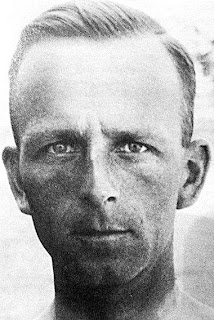
Karl Fritzsch
Franciszek Gajowniczek
August 14, 1941: After weeks of starvation, Fr. Maximilian and his fellow prisoners were barely alive. Some were so thirsty that they resorted to drinking their own urine. Yet, not a sound of anguish was heard to come from the bunker; instead there were those of prayers and hymns by the prisoners led by Fr. Maximilian. Finally, the Nazi officials decided that the cell had to cleared-out to make room for other prisoners. As the executioner entered the bunker, Fr. Maximilian, the only one left who was fully conscious, said a prayer and offered his left arm to be injected with a lethal dose of carbolic acid. On the eve of the Feast of the Assumption of the one whom he devotedly loved all his life, Maximilian died.
1945

August 9, 1945: the United States dropped an atomic bomb on Nagasaki, Japan. Mugenzai no Sono sustained minimal damage, with the other side of the mountain on which it was built taking the worst of the blast. It remains one of the most prominent monasteries in Japan until this day.

1969January 30, 1969: Pope Paul VI approved the heroic virtues of Fr. Maximilian and declared him “Venerable”

1971October 17, 1971: Pope Paul VI beatified Fr. Maximilian as “Confessor” at St. Peter’s Basilica in Rome, Italy

1982October 10, 1982: Pope John Paul II canonized Fr. Maximilian, his compatriot, a saint and “Martyr of Charity”.
Pope John Paul II and Franciszek Gajowniczek at the canonization of St. Maximilian Maria Kolbe (1982)
Every August 14 (St. Maximilian Maria Kolbe’s feast day), until his death on March 13, 1995, Franciszek Gajowniczek went back to Auschwitz to commemorate the life of the saint who died on his behalf.
Franciszek Gajowniczek (1995)
“No one has greater love than this, to lay down one's life for one's friends.” 
(John 15:13)

Monday, April 19, 2010

Herman the Cripple

Herman of Reichenau (1013-1054) was born w/ cleft palate, cerebral palsy and spina bifida (split spine). He was so terribly deformed that he was powerless to move without assistance and could hardly speak. He was placed in a Benedictine monastery at the age of 7 by his parents who could no longer look after him. He was professed as a monk there at age 20. 

Despite his physical limitations, Herman was considered a genius. He was literate in several languages, including Arabic, Greek and Latin. He was a gifted mathematician and astronomer. He built astronomical equipment and musical instruments. When he eventually became blind due to his afflictions, Herman began writing prayers and hymns (Salve Regina) and became one of the most famous poets of his day. 

Remarkably, although Herman suffered much, he is said to be always cheerful and happy. He saw each trial as a means of purification and a way to be closer to God. 

The following poem was written by William Hart Hurlbut, a physician admirer of Herman. 


Herman the Cripple

I am least among the low,
I am weak and I am slow;
I can neither walk nor stand,
Nor hold a spoon in my own hand.

Like a body bound in chain, 
I am on a rack of pain, 
But He is God, who made me so,
That His mercy I should know.

Brothers do not weep for me!
Christ, the Lord, has set me free.
All my sorrows he will bless;
Pain is not unhappiness.

From my window I look down 
To the streets of yonder town, 
Where the people come and go,
Reap the harvest that they sow.

Like a field of wheat and tares,
Some are lost in worldly cares;
There are hearts as black as coal,
There are cripples of the soul.

Brothers do not weep for me!
In his mercy I am free.
I can neither sow nor spin,
Yet, I am fed and clothed in Him.

I have been the donkey’s tail,
Slower than a slug or snail;
You my brothers have been kind,
Never let me lag behind.

I have been most rich in friends,
You have been my feet and hands;
All the good that I could do,
I have done because of you.

Oh my brothers, can’t you see?
You have been as Christ for me.
And in my need I know I, too,
Have become as Christ for you!

I have lived for forty years
In this wilderness of tears;
But these trials can’t compare
With the glory we will share.

I have had a voice to sing,
To rejoice in everything;
Now Love’s sweet eternal song
Breaks the darkness with the dawn.

Brothers do not weep for me!
Christ, the Lord, has set me free.
Oh my friends remember this:
Pain is not unhappiness.

Reference/s:
Groeschel, Benedict J. (1993). Stumbling Blocks or Stepping Stones. Paulist Press.