Monday, November 5, 2012

The Real Face of Jesus? 2

The post with the most page views on this blog is “The Real Face of Jesus?” which is based on the HISTORY channel special. This maybe because both believers and unbelievers alike are interested to see what’s probably the most accurate image ever made of Jesus.

The creative team behind the awesome images are the graphic artists from Studio Macbeth headed by Ray Downing. Upon visiting their website, I found out that they have made new renderings based on the Shroud of Turin.


HISTORY channel also collaborated once again with Studio Macbeth for a new special titled “Jesus: The Lost Forty Days”. While the new visuals are stunning, the same cannot be said of the documentary. The running time is overly extended by rehashed content from “The Real Face of Jesus”. The documentary also jumps on the “Da Vinci Code” bandwagon and gives too much attention and credence to the heresy of Gnosticism and the so-called gnostic gospels. We must remember that the early Christian Church, naturally the best judge of which stories about and which teachings of Jesus were authentic, condemned the gnostic or “lost” gospels as heretical. Nevertheless, the new images depicting our Lord are worth seeing.


All images courtesy of:
www.raydowning.com
www.history.com

Sunday, October 7, 2012

Quote of the Dei (# 7)

photo courtesy of jessilicious6

"Faith is what gets you started.
Hope is what keeps you going.
Love is what brings you to the end."
 
Mother Angelica

Wednesday, October 3, 2012

Why I’m Opposed To The Reproductive Health Bill (Part 4)

photo courtesy of AnnuskA - AnnA Theodora
 Conclusion
  • Plurality of Society
Some Catholics, perhaps wanting to play safe, say “I’m personally opposed to the RH Bill, but I don’t want to impose my beliefs on others”. On moral issues however, we simply must have the courage to take a stand. For example, we cannot say “I’m personally opposed to murdering innocents but I don’t want to impose my beliefs on others”. While we acknowledge pluralism, we must also have the integrity and conviction to stand up for our beliefs.
  • Hypocrisy
At times during discussions regarding the bill, we hear those in favor accuse those opposed of hypocrisy. I believe hypocrisy deserves to be discussed in an entry of its own, but in the meantime I’d like to share a quote from philosopher Peter Kreeft on the subject:
“…if a Catholic comes to believe the Church is in error in some essential, officially defined doctrine, it is a mortal sin against conscience, a sin of hypocrisy, for him to remain in the Church and call himself a Catholic…”
I agree and also think that while an “honest believer” is best, an “honest unbeliever” is better than a “dishonest believer”. Perhaps now is an opportune time for us Catholics to seriously reflect on our own beliefs.
  • Cafeteria Catholics
Religious demographics of the Philippines show that 80% of Filipinos are Catholics. Ironically, surveys also show that 80% of Filipinos are in favor of the RH Bill and want it passed into law. This is a clear indication that the Philippines is a country of Catholics only in name but not in practice.
What makes us Catholic? Millions of Filipino Catholics mourned the passing of Pope John Paul II, but shedding tears at the death of a saint doesn’t make one Catholic; mere sentimental reasons won’t suffice – we must also heed the wisdom of their words and live by their example. Let us therefore be faithful to the church’s teachings on sexual morality.
A good thing that is coming out of these discussions is that we’re given the opportunity to discover the real depth of our faith or lack thereof.
Do we believe the Church simply because that’s what our Lord Jesus Christ asks of us?
Do we believe the Church only when we agree with her teachings?
Do we believe the Church only when it’s easy for us to do so?
Now is a good time for each of us to reflect on our personal beliefs. It’s also a time for us to remember: that to be Catholic means we must accept, not just some, not just most, but all of our Lord Jesus Christ teachings, revealed and made known through His bride and our mother, the Church; that we cannot have Easter without Good Friday; that we cannot have Christ without His cross.

“…if, of the things taught by the Church, he holds what he chooses to hold, and rejects what he chooses to reject, he no longer adheres to the teaching of the Church as to an infallible rule, but to his own will.”St. Thomas Aquinas

Part 4

Tuesday, October 2, 2012

Why I’m Opposed To The Reproductive Health Bill (Part 3)

photo courtesy of TARIQ-M
Arguments Commonly Used By The Reproductive Health Bill Supporters 
  •  “The Catholic Church does nothing (or very little) to address the problem of poverty in the country.”
It’s everyone’s responsibility to help alleviate the suffering of their countrymen, not just the government nor the church’s. While all faithful are called to perform works of mercy (feed the hungry, give drink to the thirsty, etc.), we must remember that our Mother Church’s main mandate is to save souls – and this is exactly what she’s doing by opposing the bill.
  • “Passing the RH Bill is essential for the country’s economic growth.”
Unless problems such as rampant corruption and lack of discipline are first addressed, any development would be improbable. But even granting (without accepting) that the bill is vital in solving the country’s economic woes, should we pay for it with our souls? The church has always taught us that “the end does not justify the means”. Pope Paul VI, preaching against the use of contraceptives, stated the same in Humanae Vitae: “it is never lawful, even for the gravest reasons, to do evil that good may come of it.” (18)
  • “RH Bill promotes responsible sexual behavior.”
A closer look into the issue indicates the opposite; contraceptives are used by people who want to have sex minus the responsibility. In this way, both men and women are treated as mere objects and sex is viewed as merely an activity for one’s own pleasure. Thus, a culture of contraception actually promotes sexual irresponsibility and promiscuity.
  • “RH Bill has nothing to do with abortion.”
While the bill states that abortion is a crime, it contradicts itself by promoting the use of abortifacients such as IUD. Even in ideologies espoused we can see a connection, for we often hear supporters of the bill claim that “RH bill is about freedom of choice” – and once again we hear the misuse of the word “choice”, also a favorite misdeed of the “Pro-Choice/Abortion” movement. Some supporters even go so far as to call for the legalization of abortion in the country. Such acts give further credence to fears that the bill is merely the camel’s nose and once passed, abortion, its body, will soon follow inside the tent. What does abortion have to do with contraception? Everything, for abortion is simply backup contraception.

Part 1
Part 2
Part 3
Part 4

Saturday, September 29, 2012

Why I’m Opposed To The Reproductive Health Bill (Part 2)

photo courtesy of maremaremare
Catholic Teaching on Sexual Morality

Like any good parent, the Church reminds her children not only what is forbidden but also why it is so. To understand why contraception is immoral, we need to remember our Church’s teachings on the essence and meaning of sex.
  • Sex is sacred.
This has often been said but what does it mean? We say this mainly because through sex, God creates the miracle of life; through sex, God made co-creators of husband and wife. Therefore, to use contraceptives, is to contracept not only God’s creative powers but ultimately, God Himself.
  • Sex is for procreation.
We need to remember that the natural purpose of sex is for procreation. Sex, if we let nature takes its course, creates babies – new persons with immortal souls. Therefore, to hinder conception by the use of contraceptives is a perversion of nature.
  • Sex is an act of spousal love.
During sex, spouses mutually surrender themselves to one another; 9 months later, the love between husband and wife becomes another person. In Theology of the Body, Pope John Paul II tells us that in a profound way, sex, as an act of spousal love, mirrors the eternal exchange of love within the Blessed Trinity. Therefore, the use of contraceptives reduces sex from an expression of agape to that of mere pleasure; from an act of selflessness to that of selfishness; from a reflection of the Divine Love to that of an animal impulse.

Part 1
Part 2
Part 3
Part 4

Friday, September 28, 2012

Why I’m Opposed To The Reproductive Health Bill (Part 1)

photo courtesy of xlynx
Let me get straight to the point: I’m opposed to the Reproductive Health Bill because I’m Catholic; I don’t see how it’s possible to support the bill while remaining faithful to fundamental Catholic teachings on sexual morality. The following are my reasons for believing so:

Teaching Authority of the Church

The Magisterium has always, that is, from the very beginning, condemned the use of contraceptives as a sin.
  • According to the Catechism (summary of Catholic beliefs):
“…“every action which, whether in anticipation of the conjugal act, or in its accomplishment, or in the development of its natural consequences, proposes, whether as an end or as a means, to render procreation impossible” is intrinsically evil…” (2370)
Moreover, 2 essential encyclicals further expounds on the immorality of contraceptives:
“Similarly excluded is any action which either before, at the moment of, or after sexual intercourse, is specifically intended to prevent procreation—whether as an end or as a means.” (14)
“Two actions that are ethically different, indeed, even opposed, derive from this: the natural regulation of fertility is morally correct; contraception is not morally correct.” (118 – Faithfulness to the Divine Plan in the Transmission of Life)
These are just a few of the many Church teachings condemning the use of contraceptives. One would expect these to be definitive enough to settle the issue, yet some Catholics, including few members of the clergy, still question the Church’s teachings on contraceptives. Further reflection would lead one to remember the fact that heresies have always been a part of the Church’s history. To my mind, there is no doubt that the greatest heresies of this day and age are those concerning sex and consequently, contraceptives.

Our Mother Church’s teachings are very old; in fact, she teaches us nothing new, but merely interprets the lessons given by her Divine Founder. Therefore, due to its divine origins, her teachings are constant and unchanging. Contrary to what some may believe, her stance on controversial issues such as homosexual marriage, female priestesses, abortion and contraceptives doesn’t rest on having a “liberal” Pope or not; the Vicar of Christ can only affirm but can neither abolish nor alter the commandments given by Christ Himself. She is faithful, not fickle; her teachings concern only with the Truth, not with what’s deemed “politically correct”. As Pope Benedict XVI said, “What was true yesterday is true also today”.

Part 1
Part 2
Part 3
Part 4

Saturday, August 18, 2012

An Angel Named Job

2008
To see anyone in pain is difficult, but the sight of a child undergoing much suffering is hard to bear. I first heard of Job McCully's story via an episode of Extreme Makeover: Home Edition – one of the few, “food for the soul” types of show on TV. I’m not much for sentimentality, but the story of this boy's pain and suffering just broke my heart.

Before leukemia:


Job was only 4 years old in 2002 when he was diagnosed with leukemia and given less than 10% chance of survival. After receiving chemotherapy and a bone marrow transplant, he was eventually able to beat the cancer. However, because of the treatment, he developed fungal pneumonia which caused severe damage to his lungs. At one point, his heart stopped beating for 8 minutes but he miraculously survived. In 2007, he underwent a double lung transplant surgery. While the operation was a success, there was only so much pain and suffering Job’s little body could take. He developed cataracts in both eyes and was confined to a wheelchair. His medications contributed to an excessive weight gain and a bloated appearance. His immune system has become very fragile and he also now has diabetes.

with dad Robert
with mom Tina
with grandma Glenda
physical therapy
taking meds
“He’s been such an inspiration to so many people. And he’s only 10 years old.” 
Robert, Job’s dad

 
Yet, in spite of all the pain and suffering Job underwent and is still undergoing through, he still manages to smile – and a more beautiful sight one will never see. His courage and will to survive is rarely seen in anyone, much less that of a child. Job has become an inspiration and a symbol of hope to everyone who hears his story. Job is my hero.

thumbs up
After doing some research, I was happy to find out that Job’s health is continuing to improve and he is now able to walk. Like his biblical namesake who also underwent severe tribulations, I pray that God will continue to bless “Job's latter condition even more than his former one” (Job 42:12) and that little Job will live until he’s “old and full of days” (Job 42:17).

“How can you be more blessed, than to appreciate those precious moments that other people take for granted?” 
Tina, Job’s mom


I remember Mother Angelica once say on her show that children who suffered much here on earth, like Job, will be the happiest of all in heaven. To me this makes sense, for to those whom much has been given are also those who usually take blessings for granted, while those who go through much pain and suffering are also those who are capable of experiencing the greatest of joys in the simplest of things.

Angel Job
* Photos and Videos:

Have you ever seen an angel smile?
 
with sister Nicole


more recent
The McCully's
2nd Place Regional Spelling Bee
lovin' the rain
happy birthday

Extreme Makeover: Home Edition (clip)

Camping, Roasting Marshmallows and Pirates

Do you know what the word hero means?
  
* Courtesy of:
  1. Extreme Makeover: Home Edition 
  2. www.caringbridge.org/ar/job/
For more, please visit:

Thursday, August 2, 2012

Maximilian Maria Kolbe – The Saint of Auschwitz

St. Maximilian Maria Kolbe
1894

January 7, 1894: Maximilian Maria Kolbe was born Raymond Kolbe in Zdunska-Wola, Poland to a poor family. Both his parents were weavers – his father, Julius Kolbe, later joined the army and fought for Polish independence from Russia; his mother, Maria Dubrowska, later became a Benedictine nun. He was the 2nd child in a family of 3 children – like him, his brother Alphonse would also become a priest.
Maria Dubrowska
7 Years Old
1906

In the town of Pabianice, Poland, the Blessed Virgin Mary appeared to the 12 year old Maximilian. In his words:

“That night I asked the Mother of God what was to become of me.
Then she came to me holding two crowns, one white, and the other red.
She asked if I was willing to accept either of these crowns.
The white one meant that I should persevere in purity and the red that I should become a martyr.
I said that I would accept them both.”

1907 – Entered the preparatory seminary of the Conventual Franciscans in Lwow (Ukraine).
Parish Choir (1907)
1910 – Became a novice at the age of 16 and received his name in the Order, Maximilian.

1911September 5, 1911: made his first, “simple” vows.

1912November, 1912: began the study of philosophy at the Pontifical Gregorian University in Rome, Italy.

1914

November 1, 1914: Maximilian took his final, "solemn" vows of poverty, chastity and obedience. He also took the names Maximilian Maria to show his devotion to the Blessed Virgin Mary.

On the same year, his father was hanged by the Russians for treason.

1915October 22, 1915: obtained his Doctorate in Philosophy.

1917

October 16, 1917: the young seminarian gathered 6 of his friends in a room at their seminary in Rome's Via San Teodoro to establish the Militia Immaculatae (Immaculata Movement) – a movement devoted to the conversion of sinners through the intercession of the Blessed Virgin Mary.

On the same year, he began showing signs of suffering from tuberculosis, a disease which nearly killed him and caused him to be frail for the rest of his life.

1918

April 28, 1918: Maximilian was ordained a priest in Rome at the age of 24. The next day, he celebrated his first mass in the Basilica of Sant'Andrea delle Fratte at the “Altar of the Miracle”.
1918
1919

July 22, 1919: Fr. Maximilian obtained his Doctorate in Theology from the Pontifical Theological Faculty of St. Bonaventure in Rome, Italy. A Marian devotee, he also composed the Immaculata – a prayer of consecration to the immaculately conceived Blessed Virgin Mary; his insights into the Immaculate Conception will later influence the Marian theology of the Second Vatican Council.

1922 – Further spread the Movement through publishing “The Knight of the Immaculata” magazine.

1927 – Founded the Niepokalanow (City of the Immaculate Mother of God) monastery in Teresin, Poland; the community will soon grow to become one of the largest monasteries in the world at that time.

1930

Fr. Maximilian travelled to Asia to further spread the Movement.

April 24, 1930: he and his companions landed in Nagasaki, Japan. Despite arriving penniless and not speaking a word of Japanese, he began printing “Seibo no Kishi”, the Japanese version of “The Knight of the Immaculata” within a month.
1930
1931

Fr. Maximilian founded a monastery, Mugenzai no Sono (Garden of the Immaculate), on the slopes of Mt. Hikosan in Nagasaki, Japan. His choice of location to build the monastery was ridiculed by many – some thought it was unwise to build on the mountainside facing away from the town; others said it was bad “feng shui” according to local Shinto beliefs. Fr. Maximilian’s choice, however, would later prove to be providential (see 1945).

Later on, he would also travel to India to further spread the Movement.

1936

Fr. Maximilian returned to Poland because of poor health. Meanwhile, “Seibo no Kishi” circulation grew to 65,000.

1939

September 1, 1939: Nazi Germany invaded Poland marking the start of World War 2.

September 19, 1939: Fr. Maximilian was arrested for the first time and imprisoned.
Friars leaving Niepokalanow (1939)
December 8, 1939: On the Feast of the Immaculate Conception, Fr. Maximilian and the other friars were released from prison and returned to Niepokalanow the next day where they began to organize a shelter for 3,000 Polish refugees – 2,000 of whom were Jews.
Document issued by the German authorities (1940)
1941

February 17, 1941: Fr. Maximilian was arrested again and imprisoned at Pawiak in Warsaw, Poland where he was subjected to cruel treatment by the Gestapo.

May 28, 1941: Fr. Maximilian was transported via trainload of prisoners to Auschwitz Concentration Camp where he was branded/tattooed “Prisoner No. 16670”. He was specially hated by his captors for 2 reasons: being 1) Polish and 2) a Catholic Priest. Despite being ill, he was assigned the hardest of tasks and many times was tortured until he passed out. During one such incident, after being beaten and lashed by his captors, he was thrown in the mud and left for dead. He was smuggled by his companions to the camp hospital where he recovered. Upon returning to camp, Fr. Maximilian wasted no time resuming his ministry to his fellow prisoners by hearing confessions and celebrating mass.  
July 28 – August 1, 1941: During this period, a prisoner from Fr. Maximilian’s block (Block 14) vanished, prompting the Deputy Camp Commander, SS-Hauptsturmführer Karl Fritzsch, to sentence 10 prisoners from the same barracks to death in retaliation.

Karl Fritzsch: “The fugitive has not been found! You will all pay for this. 10 of you will be locked in the starvation bunker without food or water until they die!”

One of the selected men, Franciszek Gajowniczek, imprisoned for helping the Polish Resistance, cried out: “My poor wife! My poor children! What will happen to my family?”

Upon hearing this, Fr. Maximilian took off his cap and silently stepped forward.

Karl Fritzsch: “What does this Polish pig want?”

Fr. Maximilian: “I am only a Catholic priest from Poland. Let me take his place. I am old. He has a wife and children.”

According to a witness:
“From astonishment, the commandant appeared unable to speak. After a moment, he gave a sign with his hand. He spoke but one word: ‘Away!’ Gajowniczek received the command to return to the row he had just left. In this manner, Fr. Maximilian took the place of the condemned man.”

As the 10 were led off to basement bunker of Block 13 to die, Fr. Maximilian supported a fellow prisoner who could hardly walk.
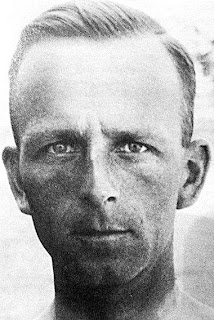
Karl Fritzsch
Franciszek Gajowniczek
August 14, 1941: After weeks of starvation, Fr. Maximilian and his fellow prisoners were barely alive. Some were so thirsty that they resorted to drinking their own urine. Yet, not a sound of anguish was heard to come from the bunker; instead there were those of prayers and hymns by the prisoners led by Fr. Maximilian. Finally, the Nazi officials decided that the cell had to cleared-out to make room for other prisoners. As the executioner entered the bunker, Fr. Maximilian, the only one left who was fully conscious, said a prayer and offered his left arm to be injected with a lethal dose of carbolic acid. On the eve of the Feast of the Assumption of the one whom he devotedly loved all his life, Maximilian died.
1945

August 9, 1945: the United States dropped an atomic bomb on Nagasaki, Japan. Mugenzai no Sono sustained minimal damage, with the other side of the mountain on which it was built taking the worst of the blast. It remains one of the most prominent monasteries in Japan until this day.

1969January 30, 1969: Pope Paul VI approved the heroic virtues of Fr. Maximilian and declared him “Venerable”

1971October 17, 1971: Pope Paul VI beatified Fr. Maximilian as “Confessor” at St. Peter’s Basilica in Rome, Italy

1982October 10, 1982: Pope John Paul II canonized Fr. Maximilian, his compatriot, a saint and “Martyr of Charity”.
Pope John Paul II and Franciszek Gajowniczek at the canonization of St. Maximilian Maria Kolbe (1982)
Every August 14 (St. Maximilian Maria Kolbe’s feast day), until his death on March 13, 1995, Franciszek Gajowniczek went back to Auschwitz to commemorate the life of the saint who died on his behalf.
Franciszek Gajowniczek (1995)
“No one has greater love than this, to lay down one's life for one's friends.” 
(John 15:13)