Wednesday, May 23, 2012

The Paradoxical Commandments

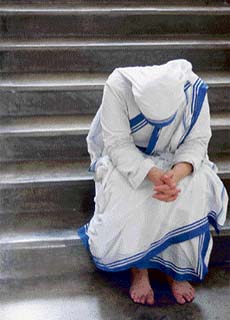
photo courtesy of Homer Page (www.time.com)

The Paradoxical Commandments
by Dr. Kent M. Keith

People are illogical, unreasonable, and self-centered.
Love them anyway.

If you do good, people will accuse you of selfish ulterior motives.
Do good anyway.

If you are successful, you will win false friends and true enemies.
Succeed anyway.

The good you do today will be forgotten tomorrow.
Do good anyway.

Honesty and frankness make you vulnerable.
Be honest and frank anyway.

The biggest men and women with the biggest ideas can be shot down by the smallest men and women with the smallest minds.
Think big anyway.

People favor underdogs but follow only top dogs.
Fight for a few underdogs anyway.

What you spend years building may be destroyed overnight.
Build anyway.

People really need help but may attack you if you do help them.
Help people anyway.

Give the world the best you have and you'll get kicked in the teeth.
Give the world the best you have anyway.

Note:
It's said that Mother Teresa had a "personalized" version of the Paradoxical Commandments written on the wall of her home. Poems can inspire us, and in Mother Teresa's case, she used one as a backbone of a life spent loving God and serving her fellow man. Mother Teresa's version can be found here.

Saturday, May 19, 2012

2 Scientists, A Rocket and A Painting (by Peter Kreeft)

photo courtesy of scottbush
When the first moon rocket took off from Cape Canaveral, two U.S. scientists stood watching it, side by side.
One was a believer, the other an unbeliever.

The believer said, "Isn't it wonderful that our rocket is going to hit the moon by chance?"

The unbeliever objected, "What do you mean, chance?
We put millions of manhours of design into that rocket."

"Oh," said the believer, "you don't think chance is a good explanation for the rocket?
Then why do you think it's a good explanation for the universe?
There's much more design in a universe than in a rocket.
We can design a rocket, but we couldn't design a whole universe.
I wonder who can?"


Later that day the two were strolling down a street and passed an antique store.

The atheist admired a picture in the window and asked, "I wonder who painted that picture?"

"No one," joked the believer;
"it just happened by chance."

Tuesday, May 15, 2012

Quote of the Dei (# 5)

photo courtesy of doublecappuccino

"Oh, I don't reject Christ.
I love Christ.
It's just that so many of you Christians are so unlike Christ.

If Christians would really live according to the teachings of Christ, as found in the Bible, all of India would be Christian today."

- Mahatma Gandhi

Sunday, May 13, 2012

Only a Real Risk Tests the Reality of a Belief

photo courtesy of Gallo Quirico
You never know how much you really believe anything until its truth or falsehood becomes a matter of life and death to you.

It is easy to say you believe a rope to be strong and sound as long as you are merely using it to cord a box.
But suppose you had to hang by that rope over a precipice.
Wouldn’t you then first discover how much you really trusted it?

The title and above quote are taken from “A Grief Observed” – a book written by C.S. Lewis that documents the crisis of faith and the grief he experienced after the death of his beloved wife.
Indeed, only during moments of despair do we truly discover the real depth of our faith or lack thereof.
I offer a prayer for anyone who stumbled upon this entry and is undergoing a personal ordeal.
And, if it’s not too much to ask, can you please send one this way as well?
May God grant us the grace to find our ropes strong enough to hold on to during our times of need.

Thursday, May 3, 2012

The Argument from Aesthetic Experience

photo courtesy of www.telegraph.co.uk
Since my taste in music is not sophisticated enough to be familiar with Bach, please allow me to share my (dumbed down) version of Kreeft and Tacelli’s “Argument from Aesthetic Experience” (original found here):

On a clear and cloudless night,
I look up to the sky and see the stars,
And know in my heart that there is a God.

You either get it or you don’t.

Wednesday, April 25, 2012

Hope and the Lazarus Miracle

photo courtesy of wondermade
It’s one of the most significant miracles recorded in the Gospels: Lazarus, a beloved friend of Jesus, had already been dead and buried for four days; Jesus, in an act pre-figuring His own resurrection, miraculously raised Lazarus from the dead. However, unlike Jesus, Lazarus did not have a glorified, resurrected body, but rather a “normal”, earthly body brought back to life. This meant he eventually (for the second time and for good), died a physical death; as to when and how, the bible does not tell us.

The miracle of Lazarus highlights a subject many don’t feel comfortable thinking of, much less talk about - death. Though we should not obsess over death, it would do well for us to contemplate it once in a while. The most obvious reason being its certainty; all of us will die someday.

Advances in medical science continuous to add years to the human life span but this merely delay the inevitable. When a loved one becomes seriously ill, we should pray for their fast recovery and healing. But even if by some miracle, a terminally ill patient gets cured, death, as it did with Lazarus, would still eventually catch up with that person. What should we do then?

Christian apologist Dinesh D’Souza suggests that more important than praying for physical healing, we also ought to pray for “a deeper kind of healing… the healing of the soul.” Perhaps a kind of healing that, as the inimitable Archbishop Fulton Sheen said, would teach us to “love goodness to a point where we can drink death like water”; a kind of healing that will prepare us to embrace, rather than fear, death; and a kind that will enable us to see death as a gateway to eternal life.

Monday, March 5, 2012

Quote of the Dei (# 4)

photo courtesy of missionary lily


"The more you care about the powerless, the more power you have.
The more you serve those with no influence, the more influence God gives you. 
The more you humble yourself, the more you're honored by others."

- Rick Warren

Monday, February 27, 2012

True Love (by Barry and Joyce Vissell)

photo courtesy of Violet Kashis
This post is a couple of weeks late, but as they say, better late than never.

Moses Mendelssohn, the grandfather of the well-known German composer, was far from being handsome. Along with a rather short stature, he had a grotesque hunchback.

One day he visited a merchant in Hamburg who had a lovely daughter named Frumtje. Moses fell hopelessly in love with her. But Frumtje was repulsed by his misshapen appearance.

When it came time for him to leave, Moses gathered his courage and climbed the stairs to her room to take one last opportunity to speak with her. She was a vision of heavenly beauty, but caused him deep sadness by her refusal to look at him. After several attempts at conversation, Moses shyly asked, “Do you believe marriages are made in heaven?”

“Yes,” she answered, still looking at the floor. “And do you?”

“Yes I do,” he replied. “You see, in heaven at the birth of each boy, the Lord announces which girl he will marry. When I was born, my future bride was pointed out to me. Then the Lord added, ‘But your wife will be humpbacked.’

“Right then and there I called out, ‘Oh Lord, a humpbacked woman would be a tragedy. Please, Lord, give me the hump and let her be beautiful.’”

Then Frumtje looked up into his eyes and was stirred by some deep memory. She reached out and gave Mendelssohn her hand and later became his devoted wife.

Saturday, December 31, 2011

The Boy at the Beach

photo courtesy of -liyen-

It was twilight and the wind, breezy. August, a local priest, just started his daily walk on a beach in Algeria.
He normally enjoys taking these walks, for he was also a philosopher, and he finds the sound of waves crashing on the shore soothing and conducive to deep thinking.
He normally enjoys taking these walks, particularly catching the first rays of sunrise; every time seems like the first, and he never forgets to offer a prayer of thanks as he marvels at the beauty of the scene.
He normally enjoys taking these walks, but not this day; for today he was in mental agony searching for an answer to one of the deepest mysteries of his faith - the Trinity.

“Three equals one!? How is this possible?” He ponders, shaking his head as he looks down at the rough, golden brown sand; his left hand touches his chin, slightly ruffling an unkempt beard.

His train of thought was all of a sudden interrupted by a peculiar sight: a boy walking towards the sea. Peculiar indeed, as August did not expect seeing another soul in such early hours, much less that of an unaccompanied boy, who he reckons, is no older than 7 years of age. Stranger still, is what the boy seems to be doing: using a seashell, he scoops water from the sea and pours it into a tiny hole, which August assumes, the boy dug on the sand. August watched as the boy repeatedly did this; tirelessly walking back and forth between the sea and the tiny hole. Finally overcome with curiosity, August approached the boy and asked:

“Child, what are you doing?”

The boy, seemingly startled and oblivious until then of someone else’s presence, stopped and turned to look at the middle-aged priest. August now had a clearer look of the boy’s face: he had chubby cheeks and short, curly brown hair. A more innocent looking face, August could not remember laying eyes upon, yet the boy had a piercing stare that elicited from the priest a feeling he did not expect: fear.

“I’m pouring the contents of the sea into the hole” the boy finally responded in a matter-of-factly manner.

 August can’t help but laugh at the absurd answer and said:

“But child can’t you see? What you’re attempting to do is impossible!”

To which, the boy replied, with a voice sounding typically like that of a child’s but somehow with the authority and conviction of an adult:

“I will sooner fill the hole with the entire sea than for you to comprehend the mystery which you’re contemplating.”
 
After the boy had spoken, a sudden wind gust blew across the beach; August slightly turned his head, covered his face with his hands and closed his eyes to protect them from sand. When the wind settled, August opened his eyes and found he was alone on the beach: the boy had vanished.

The sun had just started to rise on the horizon, its first rays shining on August’s face.

Wednesday, December 28, 2011

Quote of the Dei (# 3)

photo courtesy of Mr Din

"Character is what we are in the dark when no one but God sees us."
 
- Randy Alcorn